

Owners and managers often try to “do more with less.” Workplace safety training can feel like a line item to trim until an incident stops production, drives up insurance costs, or sends a good worker home injured. The truth is simple: safety protects both profit and people.
The return on investment (ROI) of safety training is measured through fewer injuries, lower workers’ compensation costs, reduced downtime, and stronger workforce performance. When employees understand hazards and supervisors reinforce safe practices, incidents decrease and operations run more smoothly.
According to the National Safety Council, in 2023 alone (the most recent report available), work injuries cost U.S. employers $176.5 billion in lost wages, productivity losses, medical expenses, and administrative costs. Even one claim can wipe out a quarter’s profit for a small business. That’s money that could have funded payroll, equipment, or growth.
What the data shows about workplace injuries
Private employers recorded 2.5 million nonfatal injuries and illnesses in 2024; fewer cases than 2023, but still a major operational and financial burden for many employers. In 2024, employers reported 888,100 cases involving days away from work, with a median of 8 lost workdays per incident. Even a single injury can remove a trained employee from the job for more than a week, or much longer in severe cases.
Forklifts and fall protection are repeat OSHA Top 10 citations—meaning real exposure, real fines, and preventable incidents.
The risks most likely to impact your operation are significant:
- Falls to a lower level: 666 deaths in 2024.
- Contact with objects/equipment: 756 deaths in 2024; a leading source of serious lost-time cases.
- Forklifts: 84 deaths (2024) and 25,110 serious DART cases (2023–2024). Both increased from previous reporting periods.
These facts are not theory. They come from national datasets, insurance indexes, and real-world studies. Training is one of the most direct ways companies can mitigate these costs without slowing growth.
Why small businesses can’t afford to NOT invest in safety
Small businesses often feel the impact of incidents the most. Even one claim can erase an entire quarter’s profit for a small business. OSHA’s $afety Pays tool shows the real financial impact of an injury. It estimates direct costs (medical, insurance) and indirect costs (overtime, retraining, delays). It also calculates how much extra sales you need to break even.
Example:
- Direct cost: $20,000
- Indirect cost (ratio 1.1): $22,000
- Total cost: $42,000
- Sales to break even:
-
- At 10% margin → $420,000 in new sales
-
- At 5% margin → $840,000 in new sales
Run the numbers for your operation and profit margin. It’s a quick way to show leadership why safety pays.
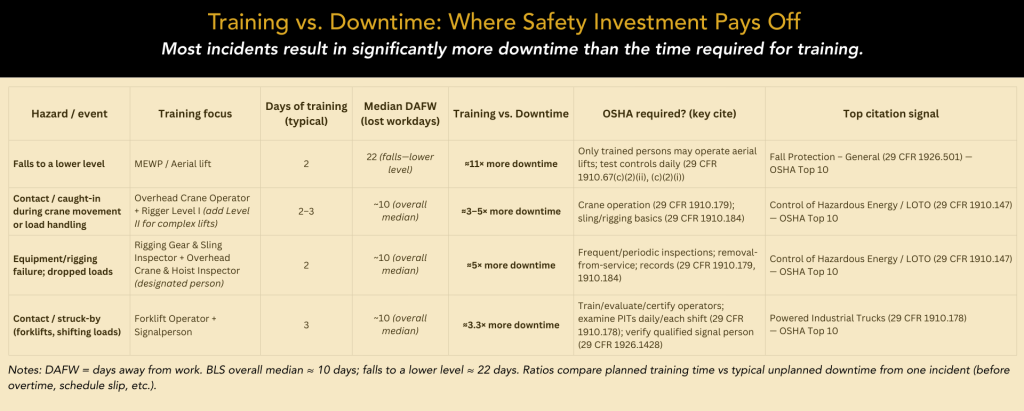
This comparison highlights how quickly training time is offset by the potential downtime from a single incident.
Where safety training investments pay off fastest
Focus first on programs where OSHA already expects training/qualification and where incidents are common and costly, even where a national certification isn’t required.
Forklifts (Powered Industrial Trucks)
- Train and evaluate every operator; keep records. (OSHA 29 CFR 1910.178(l))
- Perform a pre-use inspection daily (each shift for 24/7 operations). (OSHA 29 CFR 1910.178(q)(7))
Why it pays: avoids struck-bys, tip-overs, and property damage; forklift incidents remain a significant source of severe cases.
Aerial lifts (MEWPs) & Fall Protection
- Only trained and authorized employees may operate. (OSHA 29 CFR 1910.67(c)(2)(ii))
- Test controls each day prior to use. (OSHA 29 CFR 1910.67(c)(2)(i))
- Correctly wear and secure a full-body harness to an anchor point. (OSHA 29 CFR 1926.453(b)(2)(v))
Why it pays: Many incidents occur during setup, repositioning, or when entering and exiting the platform. Training on stability, fall protection, and site hazards helps prevent serious injuries and costly errors.
Overhead cranes & hoists
- Conduct frequent inspections (daily to monthly) and periodic inspections (monthly to annually) of overhead cranes and hoists. Employers should assign a designated person responsible for inspections and maintain inspection records. (OSHA 29 CFR 1910.179(j); 29 CFR 1910.184)
Why it pays: Identifying wear or damage in hooks, slings, wire rope, brakes, and controls early helps prevent dropped loads, equipment damage, and costly shutdowns.
Rigging & inspector training
- Perform a pre-use inspection of rigging gear each shift, remove defective equipment from service, tag out defects, and document corrective actions. (OSHA 29 CFR 1910.184(d); ASME B30 standards as applicable)
Why it pays: Recognizing worn slings, bent hooks, or damaged hardware before a lift helps prevent incidents and protects equipment.
Signalperson
- Employers must ensure signal persons are properly qualified to give hand or voice signals and recognize load hazards before directing crane operations. (OSHA 29 CFR 1926.1428)
Why it pays: Clear, consistent signals reduce crane miscommunication during lifts and help prevent struck-by and caught-between incidents.
Safety for managers (front-line leaders)
- Review the day’s work before operations begin (JSA/JHA), confirm required inspections were completed, address hazards before work begins, and reinforce key safety points during toolbox talks. (OSHA Recommended Practices for Safety and Health Programs)
Why it pays: Supervision turns training into daily habits and helps build a strong safety culture. When supervisors review the work, verify inspections were completed, and communicate hazards clearly, crews make fewer mistakes and work continues without costly interruptions. (OSHA Recommended Practices)
Make safety improvements affordable: a simple 90-day plan
- Pick two high-exposure areas to start (for many, that’s Forklift and Inspection programs). Train operators and your “designated” personnel. Put daily checklists in place.
- Train your leaders/supervisors on basics: pre-task talks, verifying inspections, fixing hazards, and documenting corrective actions.
- Track a few leading safety indicators for 60–90 days: near-misses, defects identified and corrected, training completions, and inspection compliance. Review results monthly.
- Show the financial impact: Re-run OSHA $afety Pays with your profit margin and share the “sales to break even” number along with incident trends.
What a strong safety program looks like
- Operators are trained and evaluations are documented. Pre-use checks occur before the first lift or drive.
- Cranes/hoists receive frequent + periodic inspections on schedule, with a designated person assigned and records maintained.
- Supervisors address hazards promptly and review key safety indicators each month.
The bottom line: safety training protects both people and profit
Investing in safety leads to lower injury and workers’ compensation costs, fewer delays, stronger retention, and better performance. The data is clear, and the path is practical for operations of any size. Start with your highest-exposure areas, strengthen supervisor oversight, measure what matters, and share results in both dollars and incident rates.
Why safety training matters for OSHA compliance
OSHA requires employers to ensure workers are trained and qualified for many high-risk tasks, including operating forklifts, rigging loads, working at heights, and signaling crane operators. Safety training helps employers meet these obligations while reducing the likelihood of costly incidents.
Not sure where the biggest safety gaps are in your operation? We can help.
Many companies want to improve safety but are not sure where the biggest risks or compliance gaps exist. An independent review can provide that clarity.
Crane Tech offers safety consulting services that provide an independent OSHA-style safety assessment of your operation. Our team reviews equipment, procedures, training records, inspections, and work practices to identify gaps that could lead to incidents or regulatory issues.
These reviews are conducted strictly as a private consulting service. Nothing is reported to OSHA. You receive a detailed report outlining gaps and recommended corrective actions so you can prioritize improvements.
Once gaps are identified, Crane Tech can help address them through inspections, consulting, and training programs. We can:
- Perform equipment inspections and lifting gear inspections
- Train your team to conduct rigging gear and equipment inspections beyond daily checks
- Provide crane operator, rigging, signalperson, and safety training programs
- Help establish inspection programs and documentation systems
Since 1977, Crane Tech has worked across virtually every industry—from manufacturing and oil and gas to construction, maritime, and pharmaceutical operations.
Call us at 1-800-290-0007 or visit cranetech.com to learn more.