
Smartphones, Stress, and Crane Safety: Reducing Distractions and Preventing Accidents

Distractions are everywhere, but for those in cranes and other load handling equipment, they don’t just slow down productivity—they can lead to serious, even fatal, consequences. 

As job sites become increasingly complex and crews are asked to do more, the pressure on workers is mounting. Add to that the ever-present buzz of a smartphone in someone’s pocket, or the stress of life away from home, and it’s no wonder safety professionals are raising the alarm. 

Smart Devices, Serious Risks
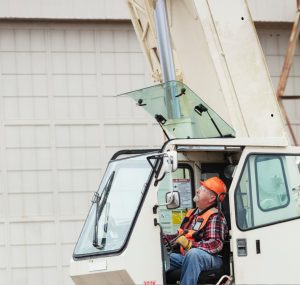
A crane operator focused on safety, preventing distractions on the job site.

Avoiding distractions is imperative for keeping jobsites safe.

We all know smartphones can be distracting, but how often do we really connect them to on-the-job accidents? 

According to a national survey by Screen Education, 26% of workers in industrial settings said accidents occurred in their workplace because someone was distracted by their smartphone. Even more alarming, these weren’t just close calls: 

  • 75% of those incidents caused property damage 
  • 58% resulted in injury or death 

And here’s the kicker—47% of respondents said their employer already had a policy in place restricting smartphone use. It’s not just about having rules; it’s about how seriously those rules are taken—and how well they’re enforced. 

We’re not suggesting you ban phones outright. In some cases, they’re a lifeline. But it’s important to help your team understand when and where it’s appropriate to use them—and the risks of using them when focus is critical. 

Mental Health on the Job 

Distraction doesn’t just come from devices. Often, the real cause is deeper: stress, burnout, and mental health struggles. 

The construction industry consistently ranks among the highest for suicide rates. Workers often face long hours, high-pressure environments, and extended time away from family. Mental health challenges—including substance abuse—are widespread across the trades. 

Unfortunately, there’s still a stigma around talking about it. But ignoring mental health doesn’t make the risks go away—it just makes them harder to see until it’s too late. 

Creating a safer workforce means supporting the whole worker. That might mean encouraging open conversations, providing access to employee assistance programs, or simply checking in with your team more regularly. 

What You Can Do 

If you’re a supervisor, safety manager, or employer, you set the tone. Start by asking: 

  • Are your workers aware of the risks associated with phone use on the job? 
  • Do you have clear expectations—and do you model them? 
  • Are you checking in on your team beyond their task list? 

Creating a safer workforce means supporting the whole worker. That might mean encouraging open conversations, providing access to employee assistance programs, or simply checking in with your team more regularly. Looking for expert guidance on crane safety training and reducing workplace distractions? Contact Crane Tech today to strengthen your team’s safety culture and reduce accidents. 

2025 Father’s Day Scholarship Winners: Building the Future of Crane Operation

Crane Tech is proud to announce the recipients of our 2025 Father’s Day Scholarship—an initiative created to support aspiring crane operators who are committed to building better futures for themselves, their families, and the industries they serve. This annual award recognizes individuals who show a strong work ethic, a commitment to safety, and the drive to succeed through professional training. 

This year’s scholarship program originally planned to award one full-tuition scholarship for a 3-week training program, along with two partial scholarships. But after reading so many heartfelt, inspiring submissions, we knew we had to do more. 

In recognition of the strength, sacrifice, and drive shown by so many, we expanded our awards—upgrading the top scholarship to a 4-week program and awarding full 3-week programs to two recipients who tied for second place. 

This year’s winners are: 

  • 1st Place: Vincente M. – Full tuition for a 4-week Mobile Crane Professional Operator Development program Crane Training Scholarship Winners
  • 2nd Place (tie): Daniel I. and Eric P. – Full tuition for 3-week Mobile Crane Professional Operator Development programs 

All three recipients are fathers whose stories reflect resilience, a desire to grow, and a dedication to building safer careers through crane operator training. 

  • Vincente M., a single father of three, has spent years balancing multiple jobs while pursuing education and certification—often sleeping only a few hours a night—all so he could build a better future for his sons. His perseverance and grit are nothing short of inspiring. 
  • Daniel I. became a stepfather to a two-year-old who quickly became his best friend—and now, with a newborn added to the family, he’s more motivated than ever to grow. He dreams of operating large cranes, not only to build a career, but to show his daughter what’s possible through dedication and drive. 
  • Eric P. worked in the railroad industry for 15 years, operating heavy equipment with confidence and pride. Now a father of two girls, he sees this opportunity as the chance to transition into a career he’s always dreamed of, and to become a role model his daughters can look up to. 

These scholarships are more than training—they represent Crane Tech’s commitment to strengthening the trades by supporting the people who power them. We’re proud to stand behind these men as they take the next step in their journeys. 

To everyone who applied: your stories moved us. Thank you for your honesty, your heart, and your vision for the future. 

And to all the fathers out there—whether you’re lifting loads or lifting up your families—Happy Father’s Day from all of us at Crane Tech. 

Interested in becoming a certified crane operator?
Crane Tech’s Mobile Crane Professional Operator Development program combines hands-on experience with classroom instruction to help you gain the skills, certifications, and confidence needed to succeed. Learn more about the 3-Week Professional Crane Operator Program. 

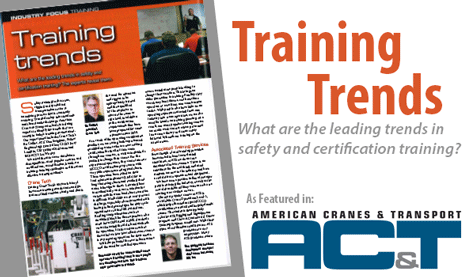
Training Trends

Safety training in the crane, rigging and specialized transportation sector is an ongoing process that is constantly evolving. Trends develop into standards and then standards change. In a recent edition, American Cranes & Transport magazine asked six training experts to identify the trends they are seeing in today’s training environment.  Crane Tech was one of those experts and here’s what Bo Collier our President had to say:

“During Crane Tech’s 40-year history I have seen training trends come and go. But one thing remains steady–that is the need for operators and riggers to be appropriately trained and then qualified by the employer to operate the crane or rig a load–in addition to the certification requirements that have been proposed for crane operators since 2010.

As a result of the upcoming certification deadline, we are seeing both experienced, qualified operators who are now seeking certification for the first time come through our courses, as well as individuals looking to change their career. For the experienced operators, they come into our NCCCO certification prep course with very little experience using load charts. These operators have relied on their load moment indicators (LMIs) for so long that using charts and reading chart notes is foreign to them. Learning how to methodically work out a solution for various mobile crane load chart scenarios is difficult. Math skills are an ever-present challenge, especially when presented with having to find percentages for duty cycle operations or critical lift restrictions. Reading comprehension can be a stumbling block for these operators who must learn OSHA and ASME standards versus knowing the old school methods for operation. It is for reasons such as these that we hear how effective our course is in preparing operators for their exams.

 With the potential for new infrastructure and the need for certified operators, we are seeing more people looking to change their vocation. This brings an older generation to training. Possibly they were heavy haul drivers, earth machine operators or even from non-construction trades. With people who have little-to-no operating experience moving from one industry into crane operation, we see the need for hands-on training growing.

As a result, our most popular training courses are multi-week courses where personnel learn crane theory and crane safety followed by hands-on training on the actual cranes.”

Click to read the full article: Industry Experts Reveal Training Trends


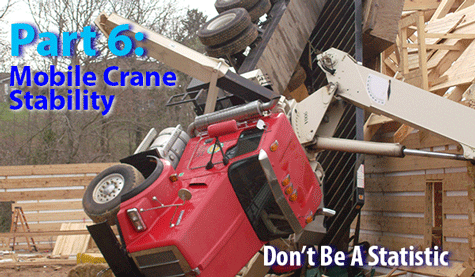
Part 6: Mobile Crane Stability – Don’t Be A Statistic

When we began this series, we mentioned that tipping is the most common type of accident with cranes.  To that end, we are trying to do our part to keep you from becoming a statistic by providing education as you work in and around cranes. We’ve looked at how gravity, balance and leverage work together to keep a crane stable, how the crane is made, what the tipping point is, and what the standards and OSHA say. Now lets apply what we’ve learned.

They say a picture is worth a thousand words, so this post will use illustrations to indicate some of the various configurations and quadrants of operation where there may be stability concerns and include images of where something went wrong. Please remember, these are only examples and it’s important that you refer to the crane operator’s manual and the load capacity chart for specifics for your crane. We cannot stress the importance enough of taking the time and making the effort to ensure proper set up, knowing your load weight, and having an educated operator–it just might save you a costly mistake. (more…)

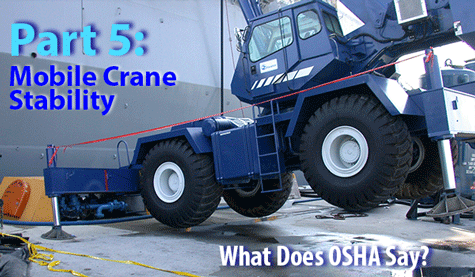
Part 5: Mobile Crane Stability – What Does OSHA Say?

As we’ve discussed earlier in this series, it would not be safe to operate a crane that didn’t have reserve stability. It would be like hoisting 2,000 pounds with a sling that is known to have a breaking strength of 2,000 pounds. So, the industry developed a suitable “margin of stability” that is applied to all cranes. In its most basic sense margin of stability means, for areas of operation that are limited by stability, there must always be greater leverage on the crane side of the tipping axis than on the load side of the tipping axis. (more…)

Crane Tech’s Expert Knowledge
NCCCO

Proudly Offering Training for CCO Certification


We offer a turn-key service for training and CCO certification testing. We will handle all training and CCO paperwork, processing, and testing for one low fee. Call today and find out how easy CCO Certification can be with Crane Tech Service.


Our Clients

[logooos_saved id="657"]
Get a Quote
Questions? Call Us!