
 We want to hear from you!
Does your current employer have a periodic rigging inspection program, and is it followed?
Click here to answer and see everyone’s responses!

We want to hear from you!
Does your current employer have a periodic rigging inspection program, and is it followed?
Click here to answer and see everyone’s responses!
A common question we get asked is how to meet a crane manufacturer’s requirements for a level crane. OSHA and ASME both state that a crane must be level to within 1-percent grade. But, what does this mean and how do you accomplish this?
Before we get too far, let’s consider what a 1-percent grade looks like. Consider a distance of 100-inches, and along this distance the ground had a difference in elevation of 1-inch. That is 1-percent. How many jobsites have you seen that are this level? Chances are some work is going to be required to meet this requirement.
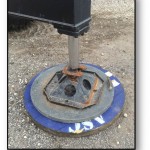 What about a crane that uses outriggers to level the crane? How level must the ground be where the outrigger floats are positioned? Applying the 1-percent rule requires, for example, a 24-inch diameter outrigger float to be level to within ¼-inch. The main point is the outrigger floats must be perpendicular to the outrigger jacks and the floats must also be level within 1-percent. (more…)
You have a rigging inspector training session so that your team has the knowledge, principles, basics, to inspect your rigging gear. During the hands-on session low and behold several, perhaps even dozens of slings and shackles get tagged as damaged and set aside. All the employees sign the attendance sheet and go back to work with a refreshed heightened awareness of how to protect, handle and inspect rigging gear. But what happens to the gear that is “tagged and should be removed” from service?
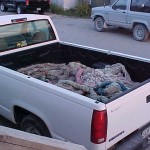 Is it just thrown in the dumpster in hopes that it never sees the light of day again?
Is it put into someone’s truck so they can use it for little stuff at home?
Is it left in a bin for someone else to handle?
Hopefully none of these answers are true at your site. It is going to take some extra effort to keep damaged gear from finding its way out of the discard pile and potentially being used again. You must not only make sure there is a plan for what needs to happen when rigging gear is removed from service, but identify and empower your employees who can make the tough call on destroying company property. (more…)
Teaching new operators the basics of load cont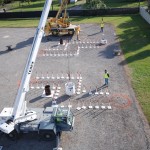 rol with seat time in our cranes. Check out our photos.
 One year ago today, I started as the Marketing Manager at Crane Tech. Little did I know there would be so much to learn and so many projects to tackle. On more than one occasion I have had my thought processes turned upside down and thought on this anniversary I’d share some of my observations from an outsider who has a new perspective for this industry. (more…)

Proudly Offering Training for CCO Certification
We offer a turn-key service for training and CCO certification testing. We will handle all training and CCO paperwork, processing, and testing for one low fee. Call today and find out how easy CCO Certification can be with Crane Tech Service.