
From Boom Truck to Big Cranes

A Father’s Day Scholarship winner finds momentum in training 

Daniel didn’t grow up around cranes, but he grew into responsibility. He’s raising a teen son and a four-year-old daughter and has a new baby on the way. That reality sharpened his goals: build a safer, stronger career and become the kind of provider his family can count on. When he talks about his kids, he lights up. It tells you exactly why he’s here. 

Before training: a ceiling on growth 

Daniel has been operating boom trucks for a commercial roofing company, primarily 30-ton units with typical picks in the 3,000 to 3,500 pound range. He got that start when Mike McEnany took a chance on him, putting him on those boom trucks even though he had no crane experience, no CDL, and couldn’t even drive a stick-shift. The work is steady but predictable. He wants a new challenge, more responsibility, and a wider skill set that opens doors beyond a single type of equipment. Financially, he felt stuck. Supporting a family raised the stakes and clarified the path: formal instruction, stronger habits, and nationally recognized credentials. 

Applying on deadline day and winning
Daniel nearly didn’t apply for the Father’s Day Scholarship. On the deadline day, he took a shot. When the award notice arrived, he couldn’t believe it – that the next step was within reach. The scholarship gave him the chance to invest in himself without placing more strain on his family. Winning the scholarship felt like a way to honor the trust Mike showed and keep the momentum going. 

Inside the classroom: confidence through clarity 

Two days into CCO preparation, the subject he worried about most—math—was already manageable. Focused practice and clear explanations helped him slow down, identify what each question is asking, and evaluate the options with more discipline. Just as important, training is reshaping a few “old-school” habits from the field. Reading why a process is done a certain way, and then practicing it, is changing how he approaches setup, communication, and documentation. That is Safety through Education in action. 

After class: exams passed 

Daniel finished his course and passed his exams. He describes walking out with his head high, feeling like the effort finally matched the outcome. The best part came later. His daughter asked how the test went. When he said he passed, her face lit up. That look nearly brought him to tears. Wins like that are why he is building a long-term career in cranes. 

Why it matters at home 

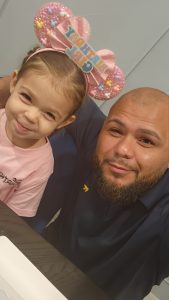
Scholarship winner, Daniel Ibarra, his wife, son, and daughter.Family is Daniel’s north star. He wants a career that challenges him and provides stability. Moving from boom trucks to larger cranes is not just about variety. It is about building long-term earning power, lowering day-to-day financial stress, and making sure he gets home safe. He looks forward to the day he can show his kids photos and videos from inside the cab and explain the planning and teamwork that make heavy lifts possible. 

What’s next: the hard jobs 

Daniel is aiming for complex work that rewards preparation and calm decision-making. Infrastructure projects and barge work are on his list because they demand strong lift planning, communication, and technical judgment. Danile’s comfort zone keeps expanding as skills build.  

________________________________________________________________________________________________________________________

Key skills Daniel is building 

  • Reading and applying load charts and range diagrams 
  • Site setup fundamentals 
  • Pre-operational inspections and documentation discipline 
  • Test-smart strategies for CCO knowledge exams 
  • Communication habits that protect the whole crew 

Thank you to our scholarship applicants 
Crane Tech’s Father’s Day Scholarship highlights learners who are ready to turn commitment into competence. Daniel’s momentum shows what happens when opportunity meets effort, one safe habit at a time. Safety through Education. 

Ready to advance your career safely? 
Call 800-290-0007 to talk with a training advisor to explore open-enrollment dates and on-site options. We will help you choose the right course and path to qualification. 

National Protect Your Hearing Month: Build a stronger hearing conservation program 

Worker in a checkered shirt and cap adjusts over-ear hearing protection while wearing safety glasses and gloves in an industrial setting.

October is National Protect Your Hearing Month 

Noise-induced hearing loss is permanent, common, and often preventable. Across many industries including construction, warehousing, ports, utilities, manufacturing, aerospace and nuclear, noise remains one of the most widespread hazards. NIOSH recommends controlling exposure to 85 dBA (8-hr TWA) or lower to reduce long-term risk. About 22 million U.S. workers encounter hazardous noise each year.  

Why it matters on real jobsites 

Hearing loss creeps up over time, quietly eroding communication and situational awareness until people start missing instructions, alarms, or back-up beepers. Beyond hearing difficulty and tinnitus, occupational noise exposure is associated with broader health concerns, including cardiovascular effects and depression, and it increases injury risk when workers cannot hear warnings. NIOSH also notes that certain ototoxic chemicals—for example, solvents like toluene and styrene or asphyxiants like carbon monoxide—can damage the ear or make it more sensitive to noise, compounding the risk in many operations.  

OSHA vs. NIOSH: what employers should know 

NIOSH sets a recommended exposure limit (REL) of 85 dBA (8-hr TWA). OSHA General Industry (1910.95) requires a hearing conservation program when exposures equal or exceed 85 dBA TWA, and it requires engineering or administrative controls when exposures exceed the 90 dBA PEL. In construction (1926.52 / 1926.101), employers must use feasible controls and provide properly fitted hearing protection where exposure exceeds permissible levels; state plans may apply stricter rules. Core hearing conservation elements include exposure monitoring, audiometric testing, hearing protection, training, and recordkeeping.  

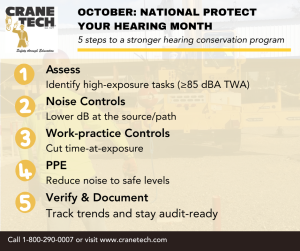
Five steps to strengthen your hearing conservation program Five-step checklist for hearing conservation—assess noise, apply noise and work-practice controls, fit hearing protection, and verify/document with training and audiometry.

  1. Assess — Measure typical tasks and shifts to identify where exposures approach or exceed 85 dBA TWA.
  2. Noise controls — Maintain, isolate, and spec quieter tools to reduce dB at the source and along the path.
  3. Work-practice controls — Rotate tasks and schedule loud work to reduce each worker’s time-weighted average and noise dose.
  4. PPE — Fit earplugs or earmuffs and replace when worn to reduce noise at the ear to safe levels. OSHA’s Hearing Conservation standard requires employers to train employees in the use and care of hearing protectors (29 CFR 1910.95(i)(4)) and to ensure proper initial fitting and supervise correct use (29 CFR 1910.95(i)(5)). 
  5. Verify & document — Train, do fit checks, perform audiometry, and keep records to stay audit-ready, spot trends, and correct gaps early.  

Helpful resources 

  • NIOSH Sound Level Meter app (iOS only, free): validated to be accurate within ±2 dBA; great for screening and education (not for compliance measurements).  
  • NHCA/OSHA/NIOSH Alliance — Hearing Protector Fit-Testing (PDF): practical intro and recommendations for conducting individual fit testing to verify protection for each worker. 

How Crane Tech can help 

A strong, defensible hearing conservation program fits inside your larger safety plan. Our team helps employers assess needs, set effective controls, train teams on hearing protector use and care with proper fit checks (per 1910.95(i)(4)–(5)), and document what regulators expect—right alongside crane, rigging, forklift, and fall-protection training. That is Safety through Education.

Call 1-800-290-0007 to talk with a training advisor or get a quote today. 

Washington State Compliance Alert

What changes mean for crew training, qualifications, and certifications 


Washington State Department of Labor & Industries (L&I) recently updated its regulations for cranes and rigging in construction. There are many changes that affect day-to-day operations. Below are the changes that affect how you may need to train, qualify, and certify your crews if you perform construction-related activities in the state. 

View the full rule: WAC 296-155, Part L 

The rule is effective September 5, 2025, (some items have later dates noted below). 

WA-Recognized Crane/Equipment Certifiers 

WAC 296-155-53100 through 296-155-53110, and 296-155-53200 through 296-155- 53214 

Being recognized to certify cranes in WA has been required for years; what’s changing is how you get and keep that authorization. You now need: 

  • A current national crane/equipment inspector/certifier credential (for the types you’ll certify) from a nationally accredited testing org (such as CCO Certification),  
  • A WA state certifier written exam (for each equipment type you’ll certify), and 
  • 40 hours of crane-related training in the prior 5 years. 

Recognition is issued for up to 5 years and must be renewed with the same elements.  

L&I also updated submission and posting steps after inspections—make sure your procedures reflect the new 5-day email and post/keep with the operator’s manual requirements. 

Assign and Qualify Lift Director & A/D Directors 

WAC 296-155-53301 and 296-155- 53303 

As of September 5, 2025, a Lift Director (LD) must be present for hoisting work and directly oversee the lift and rigging team. They must be a currently qualified rigger and currently qualified signalperson and pass a documented qualification test; qualification is renewed on a 5-year cycle. LDs are also expected to know key rule sections (assigned-personnel duties, power-line safety, operator certification criteria).  

The Assembly/Disassembly (AD) Director must be qualified (either by a third-party qualified evaluator or an employer’s qualified evaluator) and re-qualified every 5 years. Tower cranes only: the A/D Director must also hold a tower-crane A/D Director certification from a nationally accredited organization, such as CCO Certification, starting Jan 1, 2027 (or within 12 months after a qualifying program is approved).  

During tower-crane assembly/disassembly/reconfiguration, the LD cannot serve simultaneously as the A/D Director, operator, or rigger.  

Employers must ensure assigned LDs and A/D Directors are trained/qualified for their roles. 

Fall Protection on Cranes  

WAC 296-155-53403 (with 296-880) 

L&I aligned crane fall protection with the unified fall-protection rule. 

  • Provide/use fall protection at over 6 feet for non-A/D crane work. 
  • Provide/use fall protection at over 10 feet during assembly, disassembly, or reconfiguration (including tower cranes). 
  • Handholds and steps references now point to WAC 296-880. 

Ensure you update your fall-protection training content and crew briefings to these thresholds and provide refresher training when evaluations show it’s needed. Part L also requires employers to provide role-specific training and refresher training when evaluations show it’s needed. 

Wire rope inspection & removal  

WAC 296-155-53200 

Your accredited crane/equipment certifier must review the prior three months of shift rope inspections as part of certification. Removal criteria and “no-splice / two wraps on drum after shortening” expectations are clarified. 

Employers should consider refresher training for riggers and operators to recognize removal-from-service triggers and tighten inspection records. 

Forklifts lifting a suspended load (Effective January 1, 2027) 
WAC 296-155-53416 

If you hang a load from a forklift (hook, shackle, boom, winch, etc.), the operator must follow all machine/attachment prohibitions and complete the operator evaluation required by WAC 296-155-53300(3). Documentation of the operator’s qualification/certification must be available at the site (digital is accepted). 

How forklift operators qualify/certify based on configuration/attachment: 

  • Hook/shackle under forks: must meet crane-operator qualification/certification requirements in WAC 296-155-53300 (certification from a nationally accredited testing organization is required). 
  • Other attachments (e.g., boom, winch): must either hold the same crane-operator certification or be qualified by evaluation using one of two options (documentation kept on site; employer option is not portable): 
  • Option 1 – Third-party qualified evaluator; or 
  • Option 2 – Employer’s qualified evaluator with written/oral and practical tests.  

Qualifications may be valid for up to 3-years.  

How We Can Help  

Let Crane Tech help you train crews, qualify key roles, prep for certifications, and tighten records/audits so you’re ready on day one.

Get a quote to make sure you’re up to date on training.  

Perseverance with Purpose: One Father’s Path to a Better Future 

When Crane Tech launched its Father’s Day Scholarship, we hoped to support someone ready to change their life through skilled trades. We found that, and more, in Vincente. 

A single father of three, Vincente has spent the last several years rebuilding his life from the ground up. He works third shift, cares for his children during the day, and still found time to earn his GED, obtain his CDL, and become CCO-certified in two crane specialties. But his journey didn’t begin with training. It began with survival — and a turning point. 

From Burnout to Breakthrough 

Back in 2020, Vincente was exhausted. He was working up to 14 hours a day delivering appliances, then taking on evening shifts as a trash butler and weekends at FedEx. There was no time for his boys, only bills, fatigue, and getting by. 

“I couldn’t do it anymore. I was burned out. That’s when I knew something had to change.” 

He stopped making excuses and began taking steps: weekend CDL training, night classes to earn his GED, and late-night study sessions with crane operator manuals — even when they didn’t make sense yet. He leaned on persistence, faith, and a belief that failure was part of growth. 

A Single Father’s Fight

Vincente’s path hasn’t just been about career change. In 2018, he became a single father — his boys at the time were ages 8, 6, and 1. With no family nearby and no safety net, he hired babysitters, nannies, and au pairs to make ends meet. Half his income went to childcare. He fell into credit card debt, got behind on taxes, and nearly lost his car. 

But he kept going. 

“Most days, I was running on four or five hours of sleep. But I had my kids. That’s all that mattered.” 

Now, after years of sacrifice, he’s caught up on taxes, paid off debt, and in April 2025, proudly became a U.S. citizen. 

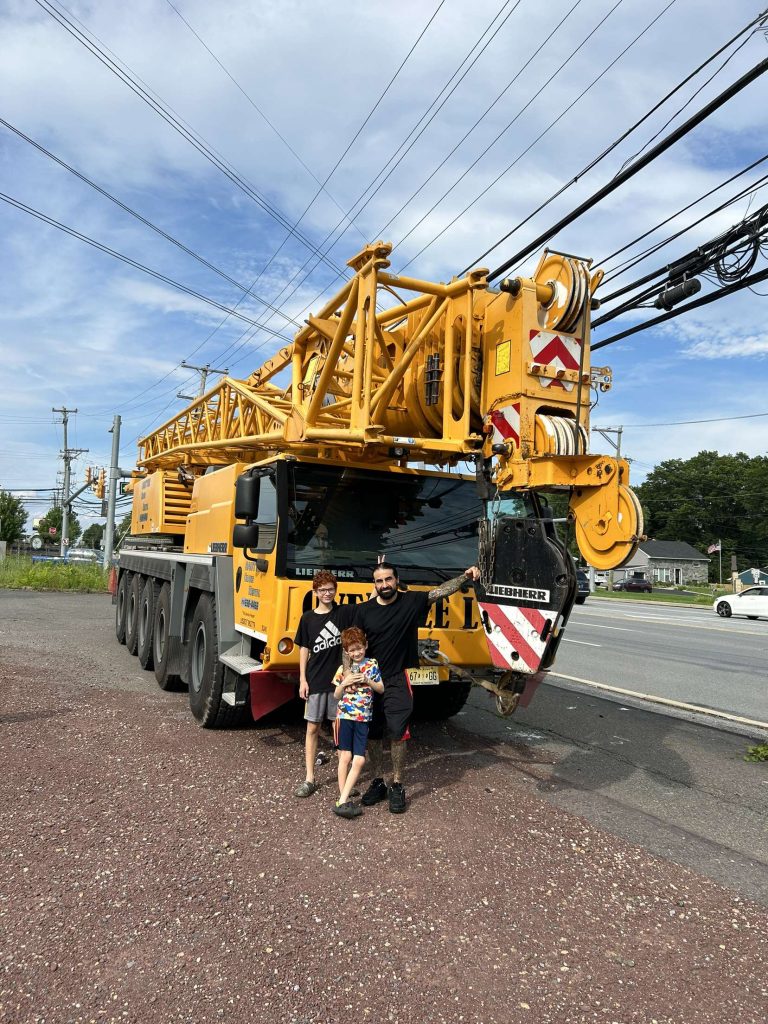
Vincente, standing with his two younger children, in front of a crane years ago.

Photographed years earlier by his oldest son during a quick roadside stop at a parked crane. “I don’t know how or when, but one day I’ll be operating one of these,” Vincente told his boys.

Why Training at Crane Tech Felt Different 

Before attending Crane Tech, Vincente had enrolled in a different program to obtain his TSS and TLL certifications. But he didn’t feel supported there. Many of his classmates had been sent by their employers, and the pace wasn’t geared toward someone still building foundational knowledge. “I felt out of place,” he shared. “I felt judged due to my lack of experience.” 

Crane Tech was a turning point. 

“For the first time, I felt like I belonged. These were my peers. The instructors explained things in a way that finally clicked.” He left the course with a stronger grasp of both theory and practical concepts. More importantly, he left with confidence that he was truly on the right path and knowing he could do this. 

Preparation Pays Off 

Vincente didn’t wait for training to start learning. Long before stepping into a classroom, he purchased industry books to explore whether crane operation was something he could pursue. Although the material was geared toward seasoned crane professionals, he powered through. He researched terms, watched videos, and taught himself as much as possible. 

“Don’t wait until you’re in class to start learning,” he advised. “Even reading a book helps. It puts you ahead of the game.” 

That habit of self-study laid the groundwork for everything that followed. 

Overcoming Setbacks and Trusting the Process 

Although he didn’t pass the written exam on his first attempt at Crane Tech, Vincente knew exactly what went wrong. It was a small, common error made by even the most experienced operators when testing under pressure. He has already scheduled a retest closer to home and feels confident that he’ll succeed. 

He’s also tackling the next hurdle: breaking into an industry where most employers want operators with prior seat time. But he isn’t waiting for the opportunity to come to him. He’s already making calls, networking, and connected with one company that may give him a shot. “I just need one chance,” he said. “I know I can prove myself.” 

He credits his resilience not just to hard work, but to faith—in the process, in purpose, and in something greater. “You have to let go of what you can’t control,” he said. “One door might close, but another will open.” 

Lifting Others as He Climbs 

While at Crane Tech, Vincente quietly stepped into the role of peer mentor. One of his classmates—a fellow Spanish speaker—was struggling with the language barrier. Vincente offered to help, translating when needed and encouraging him throughout the course. 

“He didn’t need much,” Vincente said. “But I know what it’s like to feel out of place. I just wanted to help.” 

Sometimes, the biggest impact comes from simply showing someone they’re not alone. 

What His Children See 

Vincente’s greatest motivation has always been his three boys. They’ve seen him sacrifice, study, and keep moving , no matter how tired he was. And now, they’re carrying that example forward. 

His oldest son, now 16, excels in school, helps care for his younger siblings, and spends his free time studying. He doesn’t do it because he’s told to. As he once told his dad, “I learned this dedication from you.” 

Vincente hopes that all three of his kids carry that message with them: change takes work, setbacks aren’t the end, and every step forward matters. 

“Nothing is easy—but everything is possible. I want them to see that.” 

Gratitude and Grit 

Through every challenge, Vincente remains deeply grateful for the opportunity to grow and for the people who believed in him. 

“I can’t thank you enough. You have no idea what this meant to me.” 

He’s not finished. His path is still unfolding, and his focus hasn’t wavered. 


Crane Tech is honored to support individuals like Vincente—those who show up, work hard, and inspire everyone around them. We’re excited to be part of your journey, Vincente, and can’t wait to see what’s next for you. 

Plan Ahead & Save: 25% Off Winter On-Site Training

Book by Close of Business Tuesday, September 30

Planning ahead pays off. Now through September 30, you can save 25% off our standard daily training rate when you schedule 2 or more days of on-site training for November, December, or January. 

Crane Tech training helps your team meet OSHA regulations and industry standards—with experienced instructors who bring real-world credibility and a passion for building safer workplaces. 

Whether you’re preparing new hires or reinforcing safety for your current team, this limited-time early bird offer gives you access to expert instruction at your location and at a reduced cost. 

Sample Savings on Popular Courses 

  • Qualified Rigger Level 2 – Save $2,100 
  • Overhead Crane Operator – Save $1,500 
  • Mobile Crane Operator – Save $2,800 
  • Master Rigger – Save $2,800 

Offer Details 

  • Book by COB Tuesday, September 30 
  • Applies to 2+ day training at your location 
  • Discount applies to daily training rate only (travel not included) 
  • 25% non-refundable deposit due at booking 
  • Mention code EARLYBIRD2025 when calling 

Ready to Get Started? 

Call 1-800-290-0007 to speak with a Training Advisor and lock in your discounted rate and dates. 

Slots are limited—once dates are filled, they’re gone. 

Crane Tech’s Expert Knowledge
NCCCO

Proudly Offering Training for CCO Certification


We offer a turn-key service for training and CCO certification testing. We will handle all training and CCO paperwork, processing, and testing for one low fee. Call today and find out how easy CCO Certification can be with Crane Tech Service.


Our Clients

[logooos_saved id="657"]
Get a Quote
Questions? Call Us!