From This to That: Sling Fabrication

Several weeks ago Crane Tech identified a need for a new 3-leg bridle for our test weight to replace the nylon versions. So we contacted Certified Slings & Supply™ to order just what we needed.

When it was time for the slings to be fabricated, our Marketing Manager asked to watch the process to be able to share it with our Hooked On Crane Tech readers.   Feeling inspired from the fabrication, we created this little video to show the steps a Certified Sling goes through from beginning to end.

(Video may require Chrome or Safari to play properly.)

 About The Flemish Eye

The Flemish Eye is the most popular sling eye in wire rope slings, (more…)

4 Points on Inspections

4-points-inspection475

We were recently asked, “Is it is required to have a third-party perform OSHA inspections on cranes?” and thought the response was worth sharing with others.

Our answer was: “OSHA is very clear that cranes must receive inspections on a regular basis and under various circumstances, and these inspections must be performed by either competent or qualified persons. However, there is no mention in U.S. Federal OSHA for cranes operating in a construction environment or general industry environment that requires this person to be a third-party inspector.

While this seems to be a straight forward question and response, we found that in just one answer there were several areas that needed clarification. As a result, we developed these four points regarding inspections and the qualifications of the personnel performing them. (more…)

How Do You Work Around Power Lines?

powerlinesafetyheader475

The requirements for working around power lines haven’t changed in six years. So why are we still hearing about accidents, injuries, and deaths from cranes and equipment getting too close or coming in contact with power lines?

Just this past week, two construction workers in Georgia were electrocuted when a crane came in contact with the power line. This accident could have been avoided. It’s instances like these that reinforce the need for continual education regarding workers in the vicinity of power lines.

In this Crane Tech article, published in Construction Business Owner magazine, we elaborate on the two parts of safety for working around power lines according to OSHA:

  1. Clearance Distances – for cranes and the  steps that must be taken to work near power lines
    AND
  2. Training – for those involved in crane operations AND for personnel who are working on the site but are not directly involved with crane operations

Check out CBO: What Does It Take To Work Around Power?  to refresh your knowledge about power line safety.
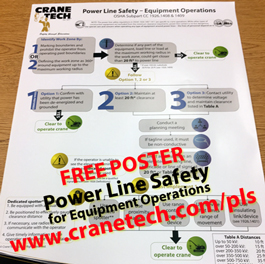
freeplsposterad265

As seen in the article: FREE Power Line Safety Poster!

Simply register at: www.cranetech.com/pls
Our gift to you for being a Hooked On Crane Tech reader!
  • Outlines OSHA Subpart CC 1926.1408 &1409
  • Easy to follow work flow
  • Perfect size for job site trailers
  • Use for ALL types of equipment operations to keep personnel safe
To Tag Line or Not to Tag Line?

A Q&A on Tag Lines – Part 3

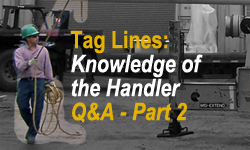
tagline-header-small-part-3Over the last two posts, we discussed the need for tag lines and their proper application, as well as what the handler needs to know before holding a tag line. This week we are moving to some more practical application questions and items that may not be discussed as often with tips to make your lifting operations safer. So let’s jump right in:
What should tag lines be made of?

According to OSHA §1926.1410(d)(7) when working in proximity to (more…)

To Tag Line or Not To Tag Line?

A Q&A on Tag Lines – Part 2

tagline-header-small-part-2In Part 1 of this post, we discussed the need for tag lines and their proper application. This week we are going to discuss the tag line handler. First of all, there is no set rule for who handles a tag line.  They may or may not be a qualified rigger, they may or may not double as the qualified signal person. But one thing for sure, they shouldn’t be just anybody off the street.  They should not be told, “Here, just hold this a minute…” there is more to it than that.

We can all agree that a 180 lb. man vs. a crane with a load is no reasonable match-up. For this reason, (more…)

Crane Tech’s Expert Knowledge
NCCCO

Proudly Offering Training for CCO Certification


We offer a turn-key service for training and CCO certification testing. We will handle all training and CCO paperwork, processing, and testing for one low fee. Call today and find out how easy CCO Certification can be with Crane Tech Service.


Our Clients

[logooos_saved id="657"]
Get a Quote
Questions? Call Us!