

Every rigger loves new slings and gear, after all who doesn’t love new stuff? But just because it’s new, doesn’t mean it is without issue. Sure, we’d like to assume that new slings and hardware are perfect and match what was ordered, but if you don’t take the time to check it out how can you be sure? In the words of the 2015 Top Professional Trainer, Jeff Ellis, “In my career I’ve seen 80% of new slings pass a good initial inspection process, leaving about a 20% issue rate. I don’t know about you, but in my opinion this makes marking a new sling as ‘ok’ without a full initial inspection not only a bad idea, it is an awful idea.”
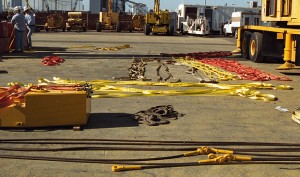 We often find that new rigging arriving for a quality check is actually only a count to ensure the quantity ordered matches the quantity delivered. However, an initial inspection is the most important thing you can do to protect your investment. Not only does it help set the stage for a good periodic inspection, it helps protect the company’s bottom line against having to dispose of gear needlessly due to issues that could have been identified BEFORE the gear was placed in service and helps to safeguard against potential accidents due to manufacturing defects or incorrect shipments. We have seen it all with regards to initial inspections, so lets look at some real life situations that can teach us a thing or two about this step in the life of your rigging gear.
Not Properly Marked
In the case of last week’s Can You Spot What’s Missing? post, where the sling was not marked according to United States (US) requirements, a proper initial inspection would have identified the problems BEFORE the sling was tagged as “ok” and placed into service. Thankfully no one was hurt, but had the issue been raised immediately, the slings could have been returned to the manufacturer for replacement without introducing unnecessary risk into the work place.
Not What Was Ordered
You order and receive 50 new 6’ web slings and look at them in the package. Yes, it’s a sling. Yes, it has a tag, and yes you can see the tag says 6’. But if you don’t take the sling out of the package, check it thoroughly and measure it, how do you know it is 6’? Just because the tag says so? Ok, so you decide to take each of them out of the package and put a tape measure against them. Lo’ and behold 5 of them are shorter than the others, check the tag, it still says 6’, but these are clearly 5’9” slings. What do you do? Now is the time to call the supplier and address the issue, not when the strap has been used for a month or two and undergoes inspection only to find that its length doesn’t match the tag. Now the sling has to be removed from service because no one knows why the length and tag do not match.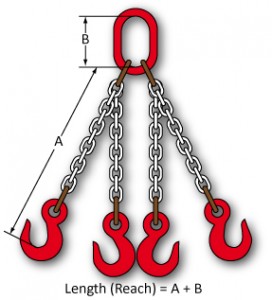
Benchmarking Sling Length
A new 10’ 4-leg adjustable chain bridle and it is delivered with the proof test certificate. If purchased from a reputable rigging supplier, you should be able to trust that the chain should support the tagged weight, but one thing these slings are famous for is not having the true length of the sling noted on the tag. Due to the very nature of chain sling, most chain sling tags don’t have the reach marked in fractional inches. If an initial inspection is not performed and the proper reach noted, then when it’s time for the periodic or annual inspection there is no benchmark to determine if there is any stretch. Since chain stretch is a major inspection criteria how do you know if your sling remains safe to use?
Damaged Gear
Your shipment of gear comes in to receiving and because no one knows what’s in the box, it is opened with the razor knife, that accidently cuts thru the plastic packaging and into the synthetic round sling. However because the clerk only sees a small slice in the package, they don’t think about the implications. Your rigging crew receives the sling with the slightly torn package, tags the sling and eventually sends it out to be used on the floor. Even though it is new, the sling has already been compromised before it has even been used and will introduce unnecessary risk into the workplace.
Sub-standard Products
Like most in the United States, we are very supportive of buying products that are made in America, so that they meet US standards. In fact, many US companies have policies restricting the purchasing and use of non-domestic products; yet, the world is much smaller these days and there are many good imported rigging products. One major US shackle manufacturer has a large portion of their product manufactured in Mexico and Canada. This isn’t the import product you need to be concerned about because these out of country manufacturing plants must conform to US standards. There are also some very quality products that come from S. Korea and Italy which also manufacture to US standards.
The shackles in the image below were both found being used in lifting operations, however they do not meet ASME B30.26 standards. If you purchase non-domestic rigging gear, please make sure a thorough initial inspection takes place to ensure compliance to US Federal and Military specifications (or your country’s specifications). Buying the least expensive shackle or chain will generally get you a product that has poor traceability and substandard manufacturing quality controls. While there may be money to be saved by looking at non-domestic products, you must be smart and not just take the word of the salesman, do your due diligence to make sure the product is safe for your application as well.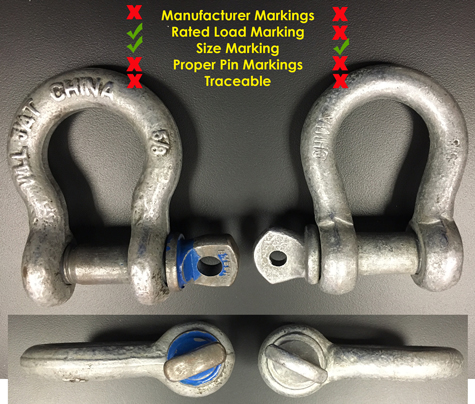
These five examples are just the tip of the iceberg as to why initial inspections must be built into the process for ALL new rigging gear. We’d love to hear your thoughts on this, your initial inspection war stories or related topics. Feel free to comment below or email us your stories.
 And don’t forget to comment on our one-question poll on your company’s initial inspection process.